
Compression Moulding of Carbon Fibre Reinforced PEEK
In an industrial environment that is increasingly demanding in terms of sustainability, energy efficiency and structural performance, high-performance thermoplastics have become a cutting-edge solution. These materials offer lightness, strength and recyclability—three essential factors for sectors such as aerospace, medical or automotive.
One of the main advantages of thermoplastics over thermosets is their ability to be melted and reprocessed, which reduces their environmental impact making recycling easier. Furthermore, they allow for faster and cleaner processes, thereby improving production efficiency.
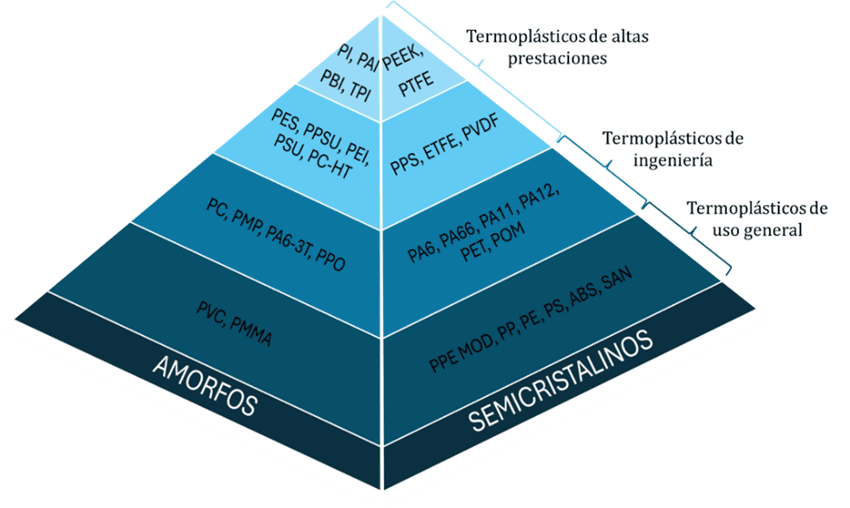
Classification of Thermoplastics According to Performance
Thermoplastics are typically classified into three levels based on their thermal and mechanical properties:
| Classification | Examples | Key Properties | Typical Applications |
| General-purpose | PE, PP, PVC, ABS | Low cost, easy processing | Packaging, piping |
| Engineering | PC, PA6, PA66, PET, PBT | Good thermal and mechanical resistance | Automotive, electronics |
| High-performance | PEEK, PPS, PI, PES, PTFE | High thermal, chemical and mechanical resistance | Aerospace, medical |
What is PEEK and Why is it So Special?
PEEK (polyether ether ketone) is a semi-crystalline polymer with outstanding thermal, chemical and mechanical properties. When reinforced with carbon fibre, its stiffness, tensile strength and dimensional stability increase significantly, enabling its use in critical structural applications.
Key Properties of Reinforced PEEK:
- Withstands continuous temperatures up to 260 °C.
- High chemical resistance to solvents and corrosive agents.
- Excellent wear and fatigue resistance.
- Low density, ideal for lightweight components.
These factors make PEEK an ideal material for high-demand applications such as aerospace. However, its main drawback—and the reason its use is not yet fully widespread—is the complexity of its processing and the associated cost.
Case Study: Manufacturing Carbon Fibre Reinforced PEEK Panels at AIMPLAS
As part of applied research, AIMPLAS has carried out an experimental study on the compression moulding of carbon fibre reinforced PEEK. The aim: to validate the technical feasibility of producing high structural quality plates for advanced applications.
Material Used
The material used for testing was a spool of unidirectional carbon fibre reinforced PEEK tapes, with a 66% fibre content. Based on this spool, the manufacture of flat panels with different configurations was designed:
- Unidirectional (UD) plate
- Symmetrical [0/90]° plate
Both versions had dimensions of 300×300 mm and a target thickness of 2 mm.
Stages of the Compression Moulding Process
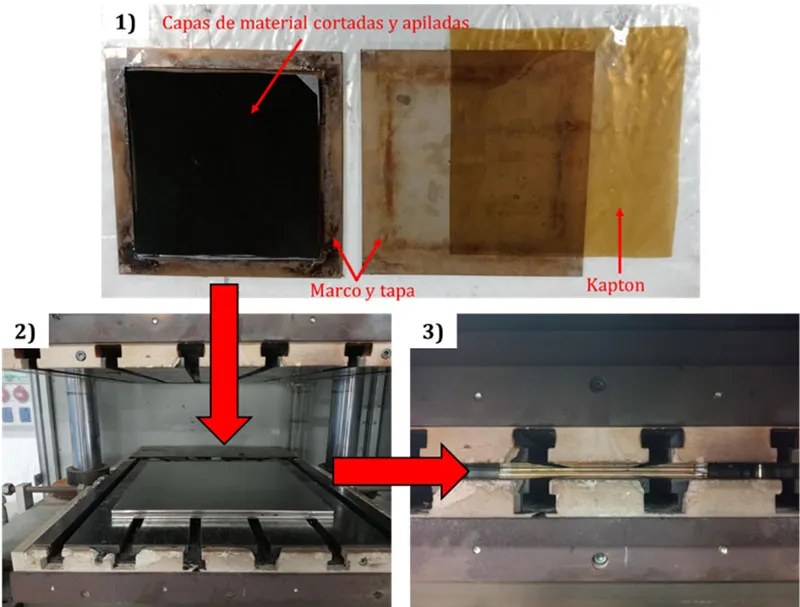
The process involved the following key steps:
1. Equipment Selection
A high-temperature press capable of reaching up to 500 °C and maintaining high heating and cooling rates was used. This press could be adapted to the requirements of the PEEK moulding cycle, whose critical conditions are:
- Temperatures up to 400 °C
- Strict control of heating/cooling to avoid defects
2. Determining the Number of Layers
Based on the nominal tape thickness (0.14 mm per ply), 14 plies were initially estimated to reach 2 mm. However, after validation tests, it was established that 13 layers were sufficient after consolidation.
3. Experimental Manufacturing and Optimisation
Pilot plates measuring 150×150 mm were produced to verify consolidation, final thickness and surface quality. Two critical effects were identified:
- Rapid cooling → poor surface finish
- Slow cooling → improved finish but longer cycle time (500 min vs 90 min)
Results and Key Observations
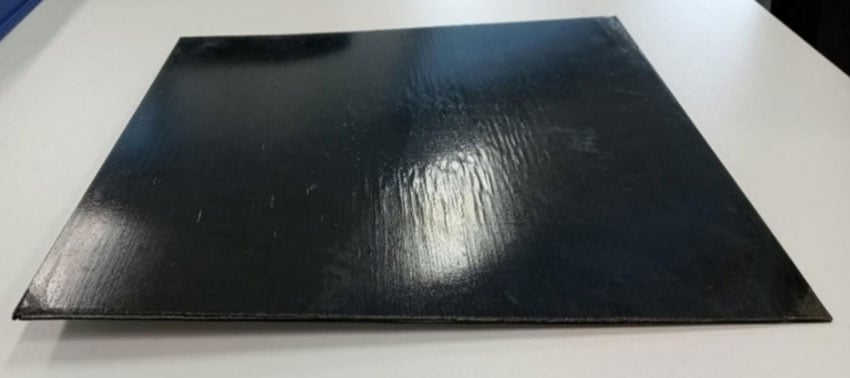
The final 300×300 mm plates showed excellent surface properties, with no dry zones or fibre misalignment. However, a warping phenomenon was observed when examining the plates perpendicularly to their thickness.
What Caused the Warping?
This defect is due to:
- Residual stresses generated by crystallisation differences during cooling
- Critical relationship between in-plane dimensions and thickness
To solve this, double-thickness plates (4 mm) were tested, successfully eliminating warping and yielding perfectly flat parts.
Thermal Testing to Understand Material Behaviour
DSC (Differential Scanning Calorimetry) was used to analyse the material’s thermal transitions before and after moulding:
- The glass transition temperature (Tg) increased from 143 °C (unprocessed tape) to 169 °C (final plate).
- Cold crystallisation was eliminated, indicating correct consolidation.
To relieve stresses and reduce warping, a thermal treatment at 180 °C (slightly above Tg) was applied for 4 hours, yielding positive results in terms of residual stresses, though not fully resolving the issue.
What’s Next? Mechanical and Microstructural Characterisation
AIMPLAS plans to progress towards:
- Mechanical testing (tensile and fatigue) to assess structural performance
- Microstructural analysis (SEM) to detect porosity, delaminations and other internal defects
Additionally, implementing moulding under vacuum conditions is being considered to minimise trapped air and improve the final material quality.
Conclusions
The study confirms the feasibility of compression moulding carbon fibre reinforced PEEK as an effective technique for demanding structural applications. Thanks to strict process control and appropriate equipment selection, high-quality parts can be produced with excellent finish and elevated mechanical performance.
AIMPLAS thus demonstrates its technological capability to tackle advanced developments in thermoplastic composite materials, positioning itself as a benchmark for innovation in high value-added sectors.
Frequently Asked Questions (FAQ)
What are the advantages of PEEK over other thermoplastics?
Greater thermal, chemical and mechanical resistance. It also offers excellent fatigue performance.
How does compression moulding differ from injection moulding?
Compression moulding is ideal for reinforced composites, as it allows greater control over fibre orientation and consolidation.
Can PEEK be recycled?
Yes. As a semi-crystalline thermoplastic, it can be reprocessed, although with certain limitations depending on its reinforcement and prior use.
Want to Know More?
If you’re interested in advanced solutions using materials such as carbon fibre reinforced PEEK, get in touch with AIMPLAS.
Javier Ramírez Conca · Sustainable and Future Mobility Group