
Use of CO2-Based Materials in Construction

The increase of carbon dioxide (CO₂) in the atmosphere due to anthropogenic emissions is contributing to the progressive development of global issues such as climate change and global warming. To combat this, new technologies are being developed to reduce CO₂ emissions and even transform carbon dioxide into new products.
Introduction to Polymers as CO₂ Storage
Carbon capture and storage (CCS) is emerging as a technology to mitigate climate change by reducing CO₂ emissions into the atmosphere.
Several CO₂ storage systems exist, including geological storage, where CO₂ is injected into deep, porous geological formations. However, one limitation of this method is the inability to provide added value to the stored CO₂. This limitation has led to the exploration of new pathways to increase the added value of CO₂.
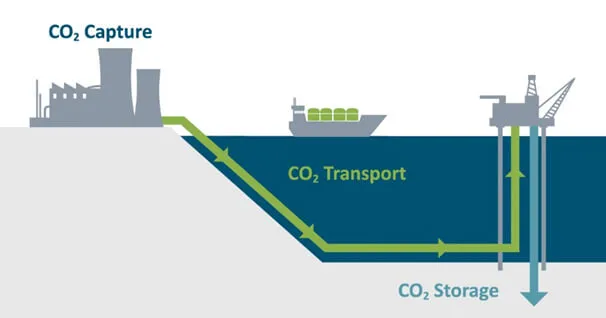
Scheme of a CO2. capture and storage process. Source: https://umsu.ac.id/berita/carbon-capture-and-storage-ccs-definisi-dan-peran-penting-di-indonesia/
Currently, CO₂ is used in various industrial sectors such as food (beverage carbonation, food preservation), metallurgy (welding and cutting), chemicals (fertilisers, urea), and water treatment (pH regulation). Additionally, new applications for CO2 have emerged, including the production of sustainable fuels, the synthesis of high-value-added chemical compounds, and the incorporation of CO2 into polymers.
Applications in Enhancing Construction Materials with Carbon-Derived Polymers
The popularity of carbon-derived polymers has grown in recent years due to their properties in terms of sustainability. Of these polymers, polycarbonates (PCs) and polyurethanes (PUs) are the most common.
Polymers in Construction
Polycarbonates are known for their properties, including strength, durability, thermal conductivity, light weight and opacity, making them suitable for use in roofing, facades, windows and greenhouses. CO₂ is of interest in alternative synthesis pathways for polycarbonates, where it reacts with epoxide-containing molecules to form linear polycarbonates.
Polyurethanes are highly versatile materials used in foams and coatings. Traditional synthesis of PUs requires isocyanates, which pose health risks. New processes now use CO₂ (through the transformation of polycarbonates) in the synthesis of non-isocyanate polyurethanes (NiPUs). Although the NiPU technology is promising, production is still largely at laboratory scale and these materials have not been effectively implemented on an industrial scale.
Green Concrete
The construction industry is among the greatest sources of CO₂ emissions and concrete production accounts for 8% of global CO₂ emitted. One innovative approach replaces cement in concrete with materials that absorb CO₂ and transform it into a useful compound through mineralization.
Classical mineralization involves the reaction of a metal oxide (e.g. CaO, MgO and Ca₃SiO₅) with CO₂ to form a carbonate. In sustainable concrete, hydrated lime (calcium hydroxide) is used, which absorbs CO₂ to generate limestone—a key component of concrete mixtures. The resulting product achieves strength properties that are similar to those of traditional concrete while shortening the curing process from days to hours, and increasing cement hardness.

Diagram of the CO₂ storage process from sustainable concrete Source: Zajac, M. Journal of CO2 Utilization, 2020, 38, 398–415
Sustainable Asphalt
Research into applications for CO₂ in asphalt production is ongoing. Asphalt manufacturing requires high temperatures (around 150°C) to reduce bitumen viscosity, which involves the use of chemical additives that raise production costs. Traditional hot mix asphalt (HMA) and warm mix asphalt (WMA) processes are not sustainable and emit greenhouse gases.
An alternative approach captures CO₂ and combines it with bitumen, water and natural additives to create less viscous, more stable bituminous mixtures. The stability of these mixtures depends on temperature and pressure, and can be improved with co-surfactants and bio-additives derived from food waste and animal fats, thereby promoting more sustainable asphalt production processes.
CO₂-derived materials, such as CO₂-polyurethane, can also be mixed with asphalt to enhance its properties. Additionally, special zeolites are being studied to lower the asphalt synthesis temperature and reduce energy consumption and CO₂ emissions. These zeolites can also adsorb CO₂ to further reduce atmospheric CO₂ levels.
Conclusions on Sustainable Solutions with CO₂
Carbon capture and storage (CCS) is essential to combat climate change, but it is also vital to explore methods that provide added value to the captured CO₂. In this context, CO₂-derived polymers, including polycarbonates and polyurethanes, provide sustainable alternatives in the construction industry. While polycarbonates offer durability and resistance, innovative non-isocyanate polyurethanes reduce health risks, though their industrial application remains limited.
Another significant innovation is green concrete, which partially replaces cement with CO₂-absorbing compounds via mineralization, thus enhancing the environmental impact and performance of concrete, and reducing construction industry emissions.
In asphalt production, research is focused on creating more sustainable alternatives such as including CO₂ in the process to reduce emissions, either by mixing it with bitumen and bio-additives or using zeolites to lower synthesis temperatures and adsorb CO₂.
Although promising, many of these solutions remain in experimental stages, which highlights the need for further research to achieve large-scale implementation.
Javier Ivañez Castellano, PhD – AIMPLAS Decarbonization Researcher
References
https://umsu.ac.id/berita/carbon-capture-and-storage-ccs-definisi-dan-peran-penting-di-indonesia/
https://www.globalccsinstitute.com/ccs-explained-transport/
Li, N.; Mo, L.; Unluer, C. Emerging CO2 Utilization Technologies for Construction Materials: A Review. Journal of CO2 Utilization 2022, 65, 102237. https://doi.org/10.1016/j.jcou.2022.102237.
Sharma, A.; Lee, B.-K. Energy Savings and Reduction of CO2 Emission Using Ca(OH)2 Incorporated Zeolite as an Additive for Warm and Hot Mix Asphalt Production. Energy 2017, 136, 142–150. https://doi.org/10.1016/j.energy.2016.03.085.
Gong, X.; Liu, Q.; Wang, H.; Wan, P.; Chen, S.; Wu, J.; Wu, S. Synthesis of Environmental-Curable CO2-Based Polyurethane and Its Enhancement on Properties of Asphalt Binder. Journal of Cleaner Production 2023, 384, 135576. https://doi.org/10.1016/j.jclepro.2022.135576.
Zajac, M.; Lechevallier, A.; Durdzinski, P.; Bullerjahn, F.; Skibsted, J.; Ben Haha, M. CO2 Mineralisation of Portland Cement: Towards Understanding the Mechanisms of Enforced Carbonation. Journal of CO2 Utilization 2020, 38, 398–415. https://doi.org/10.1016/j.jcou.2020.02.015.


