
Plastronics in polyurethane
The current market requires new lightweight polymers with electrical conductivity properties. These requirements are mainly requested by two sectors: the transport (aeronautics, automotive, etc.) and the electrical-electronic sector. This has led to developing new polymer foams by adding small quantities of nanometric fillers, thus obtaining what is conventionally known as multifunctional polymer foam.
Carbon-based nanoparticles and particularly carbon nanotubes (CNT) and graphite have reached great interest due to their inherently high mechanical properties and especially their electrical conductivity properties, which have resulted in new opportunities for the industry. The synergies found between foaming and the incorporation of nanoparticles could lead to new low-density materials with electrical conductivity properties for applications that could range from materials that prevent electrostatic discharge (ESD), such as components for fuel systems or packaging materials for sensitive elements, to protection against electromagnetic interference (EMI), such as fuel cells or boards for electronic devices, among others.
In this context, polyurethane (PU) foams play an important role. These foams have low density, high specific resistance and good impact resistance and are widely used in different sectors such as footwear, transport, construction or packaging to protect electronic components. Currently, equipment manufactured with polyurethane foam requiring electrostatic shielding or electrical conductivity properties are coated with a metallic paint that provides the part with the required electrical conductivity properties. Consequently, obtaining polyurethane foams with electrical conductivity properties is an important progress in several sectors, since it eliminates secondary painting operations and reduces the cost of the final product.
Challenges in the industry
Obtaining carbonaceous nanofiller dispersions in polyurethanes has certain industry difficulties and that is hindering their commercial application. Based on the bibliography consulted, among the factors affecting the percolation threshold and therefore the final electrical properties of polymers in general, the degree of dispersion stands out, since a higher dispersion favours conductivity, thus lowering the percolation threshold.
We can define ‘dispersion’ as a homogeneous substance, in which there is another finely divided substance, so the dispersion process consists of mixing a solid in a liquid homogeneously. We must consider that, in any process of solid-liquid dispersion, three processes occur simultaneously:
- Moistening of the particle surface
- Mechanical breakdown and separation of the associated particles (agglomerates-aggregates)
- Stabilization of particles
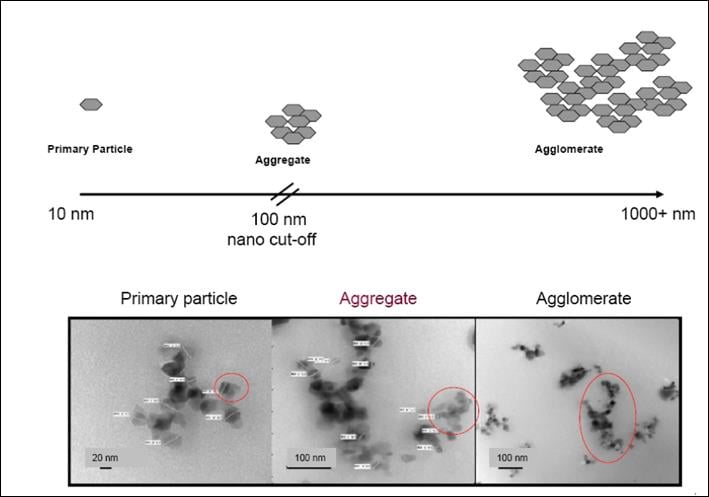
The main problem with of incorporation of nanomaterials in polyurethane polymeric matrices is their tendency to form agglomerates. Agglomerates are collections of aggregates united by weak forces that can be broken by mild forces. The size ranges of agglomerates are between 100 -1000 nm (Figure 1).
Figure 1. Difference between primary particle, aggregates and agglomerates.
From the technical point of view, the processes that must be addressed when working with nanomaterials are the removal of agglomerates, dispersion of aggregates and their stabilization in the medium. Another important aspect to consider is the increase of viscosity, which in turn hinders the proper mixing of polyol and isocyanate and prevents the use of traditional manufacturing equipment. Therefore, techniques have been developed and continue to be developed to achieve the deagglomeration, dispersion and stabilization of nanomaterials in the polyurethane polymeric matrix. These techniques include the development of polyurethane-based concentrates that are dissolved in the polyol with traditional equipment to obtain the desired electrical conductivity properties. The use of concentrates has several additional advantages with respect to the equipment and health and safety measures necessary for the handling of nanofillers since the need to work with powder nanofillers is eliminated. However, it is necessary to advance in this area and create concentrates of polyurethane-based carbon nanotubes suitable for several applications, in other words, compatible with different types of polyols/isocyanates.
We must not forget that the incorporation of carbon nanofillers also influences the material processing (gel time and polymerisation time) and the final structure of foam cells. Therefore, it will be necessary to adjust the polyurethane formulation in order to adjust these parameters to the specification of the industrial process and to the product final requirements.
AIMPLAS, within its R&D activity, develops a research line focused on the development of polymeric materials with electrical conductivity properties. With more than 15 years of experience in the plastic and polyurethane sector, we have the human and technical resources to undertake, together with companies of the sector, new research projects that contribute to developing polyurethanes to fulfil the demands of today’s market.