
High-performance bioplastics for food packaging, sports equipment and the automotive and construction sectors came together in Valencia

AIMPLAS held on 1 and 2 March the VI edition of the International Seminar on Biopolymers and Sustainable Composites, where more than 170 professionals from the sector were brought together to present their developments and discuss the challenges and trends on biodegradable plastics from renewable sources. The demand of materials from renewable resources will be doubled from 2014 to 2019 to reach 1.4 million hectares for their production, without competing with the surface for food, nearing 1,240 million hectares, according to Constance Ißbrücker, from European Bioplastics.

During the first day, different innovations in raw materials from renewable sources, such as castor-oil plant, sugar cane and corn, even milk whey, with demanding applications such as resins to produce skis and recyclable snowboards or kitesurf boards were shown, to be implemented in sectors such as the automotive and construction, requiring high performances on the part of the materials used.
The meeting has shown a progress in the use of biopolymers in the food packaging sector with developments in this field such as heat-resistant packages for ready-to-eat food or packages for fresh food with a high barrier to extend their shelf life.
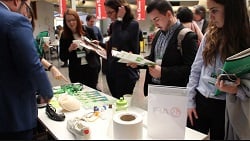
A table where sustainable coffee was served, caught the attention of the attendees, since bioplastics were in all the items used for its preparation and service: from capsules to teaspoons or cups and even the packaging of the chocolate bars, thus overcoming the challenge of heat resistance.
Success stories in biopolymers
The second day began with a review of the current standards that regulate the use of biopolymers at industrial level and then there was a space for biotechnology and production of biopolymers from natural processes, such as fermentation or from microorganisms. The seminar finished with a table of speakers where they talk about some success stories and the most recent industrial applications.
In this sense, BASF showed the new biodegradable coffee capsules developed for Cafés Novell and Renault talked about its circular economy policies and the role that biocomposites play. New developments of biopolymers for 3D printing were also launched, as well as cords for the agriculture sector and nets for the fishing sector, thanks to API INSTITUTE. AIMPLAS also presented the results of the project OSIRYS, focused on biocomposites for façades and partitions to improve the air quality.
The meeting was sponsored by: Api, Basf, Bio-Fed, CTA, Kuraray, Naturtruck, Perkin Elmer, Novamont and Wheypack.