
A project develops new biobased materials and predictive tools to improve erosion resistance in wind turbine blades
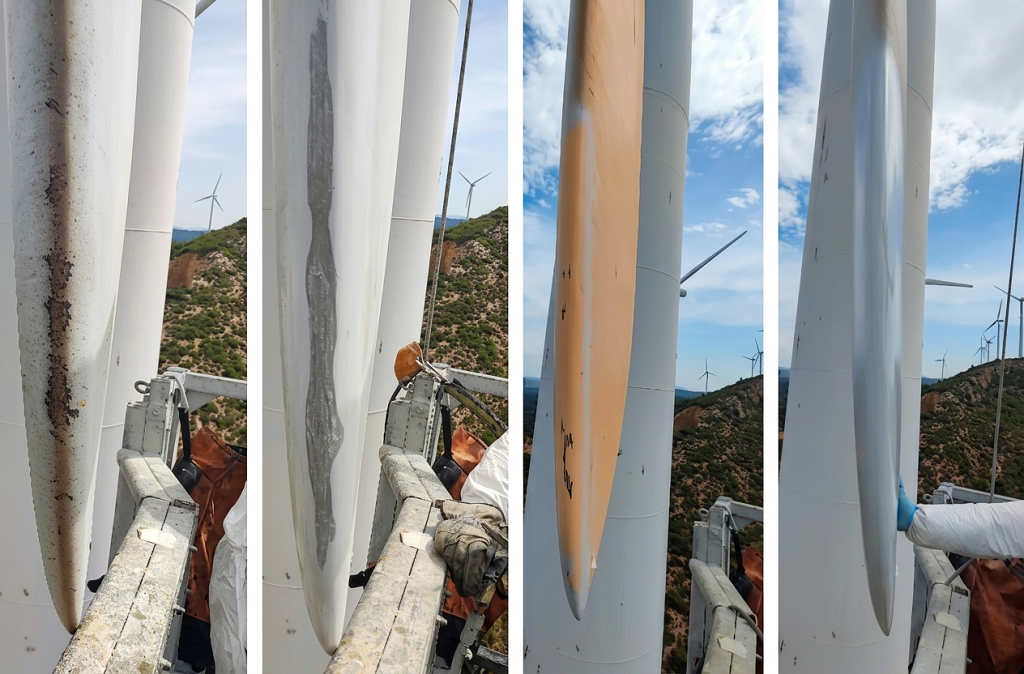
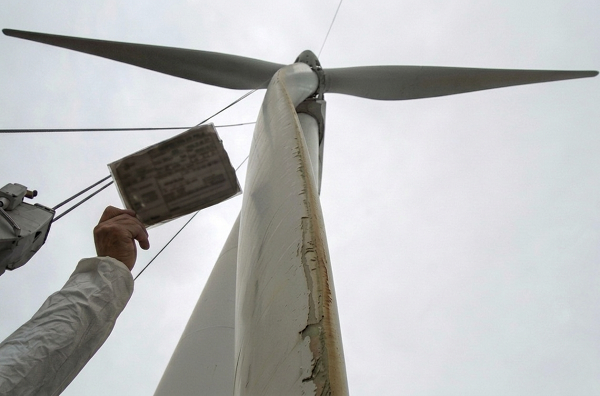
Rain-induced erosion at the leading edge of blades is one of the greatest technological challenges currently faced by the wind industry. It affects both onshore and offshore wind turbines and intensifies especially with the arrival of next-generation blades, longer and with higher speed, which increases the aggressiveness of the impact of drops, particles, and hail. This damage causes a loss of aerodynamic efficiency and, consequently, a significant reduction in annual energy production, in addition to high inspection and repair costs.
Commercial leading edge protection (LEP) systems for blades, usually formulated with petrochemical-based polyurethanes, no longer offer the performance required by the new generation of turbines. Added to this is increasing pressure from the sector to move towards materials with a lower environmental footprint, more sustainable and aligned with the principles of circular economy. This combination of factors has led manufacturers and operators to demand innovative solutions that increase durability, reduce maintenance costs, and contribute to improving the sustainability of the life cycle of the blades.
In this context, the company Aerox, the CEU Cardenal Herrera University (CEU UCH), and AIMPLAS are working within the framework of the RENEWEDGE project on a new LEP system composed of a putty and a polymeric coating formulated with raw materials from renewable sources. The project will investigate the potential of biopolyols to totally or partially replace traditional fossil-based components, seeking to achieve mechanical, elastomeric, and resistance properties equivalent or superior to current ones. To this end, the relationship between the chemical structure of the biopolyol and the final behavior of the coating will be analyzed in detail, in order to ensure a competitive solution at a technical, economic, and environmental level.
“Currently there is no commercially available biobased LEP system that meets the demanding requirements of the wind industry. With RENEWEDGE we take a step towards a new generation of leading edge protection systems. Our objective is to formulate a biobased LEP that matches or improves the performance of current solutions, but with a clear focus on sustainability and durability required by the future of the wind sector,” highlighted Asta Sakalyte from Aerox, who coordinates the project.
A predictive tool for the wind sector
One of the most innovative components of the project is the development of a computational tool capable of reliably predicting the progression of erosion damage during the service life of the blades. This system will combine traditional physical modeling of drop impact with topological data analysis (TDA) techniques to extract and describe the geometric evolution of damage from experimental tests. In addition, Machine Learning models trained with these metrics will be incorporated, which will allow correcting estimations and anticipating critical points of the material. This hybrid approach will provide a predictive solution that will allow planning maintenance operations, optimizing blade performance, and reducing uncertainty in their operation.
As stated by Fernando Sánchez, director of the Institute of Design, Innovation and Technology (IDIT) at CEU UCH and principal investigator of RENEWEDGE, “the project allows us to advance in a key line for the industry: estimating the real progression of erosion damage. The combination of experimental data with Topological Data Analysis and Machine Learning techniques offers a unique opportunity to improve the prediction of material behavior under real conditions.”
The research also includes a comprehensive analysis of the materials and processes involved in the development of the new LEP system in order to guarantee not only its technical performance, but also its alignment with sustainability principles. This work will include the evaluation of environmental impact through life cycle analysis, the study of economic viability through cost cycle analysis, and the assessment of the social impact associated with the use of the new materials. Likewise, and following the strategic guidelines of the European Union, the project contemplates carrying out a theoretical study of the digital product passport, aimed at ensuring its traceability and facilitating its future integration into a more transparent and regulated market.
“We want to ensure that the new LEP system is developed under SSbD criteria from the beginning and to evaluate its environmental impact. In addition, we are working on the necessary documentation for its digital passport, which will be essential for its integration into a future more traceable and regulated market,” concluded Maria Llàcer, researcher in Circular Economy at AIMPLAS.
The advance in biobased materials and prediction tools will allow blade manufacturers to have more durable and environmentally friendly solutions. Operators will be able to reduce costs associated with maintenance and unplanned shutdowns, while wind farm developers will have greater certainty in investment planning. In addition, the proposed approach will facilitate better management of the service life of turbines, contributing to more reliable and sustainable energy generation.
Likewise, it should be noted that this initiative is funded by the Valencian Institute of Competitiveness and Innovation (IVACE+i), through the Strategic Projects in Cooperation program in its 2024 call, and FEDER funds.
